Flickering lights, tripped breakers, or outlets that suddenly stop working can turn a normal day into a frustrating one. If you’re searching for clear, practical guidance on home electrical troubleshooting, you likely want fast answers that are safe, reliable, and easy to understand. This article is designed to help you identify common electrical problems, understand what may be causing them, and determine when a fix is simple—or when it’s time to call a professional.
We’ve based this guide on established safety standards, insights from licensed electricians, and real-world residential repair scenarios to ensure the information is accurate and practical. You’ll learn how to spot warning signs, test basic components safely, and prevent recurring electrical issues before they escalate.
Whether you’re dealing with a single malfunctioning outlet or recurring breaker trips, this guide will walk you through the essential steps to restore safety and functionality in your home.
Your Guide to Safe and Smart Electrical Troubleshooting
Electrical problems can feel intimidating, but I believe most homeowners can handle the basics safely. This guide to home electrical troubleshooting replaces guesswork with a calm, step-by-step mindset. The real danger isn’t the flickering light; it’s rushing in without a plan. Electricity is simply energy moving through conductors, and a circuit is the closed loop it travels.
Before touching anything, remember:
- Turn off the breaker
- Test for power
- Know your limits
In my opinion, confidence grows from caution. When a fix involves panels or burning smells, call a licensed electrician. Safety wins.
Decoding Your Home’s Electrical System: The Basics
The Command Center: Your Circuit Breaker Panel
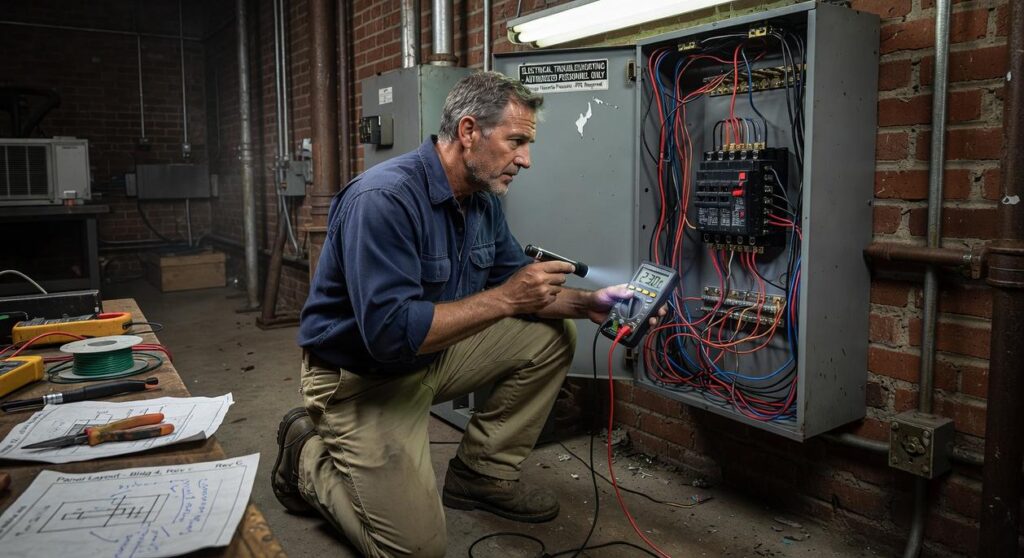
Your circuit breaker panel is the metal box—often in a garage, basement, or utility closet—that controls electricity throughout your home. Inside are individual breakers, each acting like a guard for a specific circuit. When a breaker “trips,” it shuts off power to prevent overheating or fire (think of it as your home’s built‑in bodyguard).
To safely reset one:
- Flip it fully to OFF
- Wait a few seconds
- Push it firmly back to ON
If it trips again, that’s a sign of a deeper issue worth investigating.
Key Outlet Types: Standard vs. GFCI
Standard outlets simply deliver power. A GFCI (Ground Fault Circuit Interrupter) outlet has visible “TEST” and “RESET” buttons. Found in kitchens, bathrooms, and outdoors, it cuts power instantly if it detects imbalance—like electricity heading somewhere unsafe (such as through water or you). The Electrical Safety Foundation International notes GFCIs reduce shock risk significantly.
Understanding the Flow of Power
A circuit is a loop: power leaves the panel, flows through devices, and returns. That’s why one tripped breaker can darken an entire room.
Essential Terminology
Voltage is electrical pressure. Amperage is flow strength. Wattage is total energy used (Volts × Amps). Mastering these basics makes home electrical troubleshooting far less intimidating.
Diagnosing the 4 Most Common Electrical Headaches

Electrical issues can feel intimidating. However, most common problems follow simple patterns. Once you understand what’s actually happening behind the walls, the mystery fades (and so does some of the stress).
1. The Constantly Tripping Circuit Breaker
First, let’s define a circuit breaker: it’s a safety switch in your electrical panel that shuts off power when a circuit is overloaded or short-circuited. In other words, it trips to prevent overheating and fires.
Some people assume a tripping breaker means bad wiring. Sometimes that’s true—but often it’s just an overloaded circuit.
Try the “unplug method”:
- Turn off the breaker.
- Unplug everything on that circuit.
- Turn the breaker back on.
- Plug devices back in one by one.
If the breaker trips after plugging in a specific appliance, you’ve likely found the culprit. Space heaters and microwaves are frequent offenders (they draw high wattage). Pro tip: Avoid running multiple high-demand devices on the same outlet line.
2. The Completely Dead Outlet
Next, a dead outlet doesn’t always mean it needs replacing. Start simple.
- Check the breaker panel.
- If it’s a GFCI outlet (Ground Fault Circuit Interrupter, designed to shut off power when moisture or imbalance is detected), press the “RESET” button.
- Check nearby outlets—many are linked on the same GFCI circuit.
- Use a voltage tester to confirm there’s no power before touching wires.
This step-by-step approach keeps home electrical troubleshooting safe and logical.
3. Flickering or Dimming Lights
Now, context matters. If one bulb flickers, it’s usually a loose bulb or failing filament. Tighten it gently and see if that solves it.
However, if multiple lights flicker, that could signal a broader circuit issue—or even a main service connection problem. Think of it like your home briefly “blinking.” In that case, professional inspection is wise.
4. A GFCI Outlet That Won’t Reset
Finally, a GFCI that won’t reset is doing its job. It may have:
- No incoming power (check the breaker)
- Detected a ground fault
- Internally failed
If the breaker is on and it still refuses to reset, replacement may be necessary. Electrical safety features can be annoying—but they’re far better than the alternative.
For other DIY fixes around the house, check out this helpful resource: diy wall crack repair guide for beginners.
The DIY Electrical Toolkit: Must-Haves for Safety and Success
First and foremost, buy a non-contact voltage tester. This small pen-like device detects live current without touching exposed wires, making it essential for safe home electrical troubleshooting. Simply hold it near a wire or outlet; if it lights up or beeps, power is present (and that’s your cue to step back). Some argue you can just flip the breaker and trust it’s off. I don’t recommend that—panels get mislabeled more often than we’d like.
Next, choose insulated screwdrivers with rubber or plastic-coated handles rated for electrical work. They create a protective barrier against shock. In addition, keep wire strippers and needle-nose pliers on hand. Strippers remove insulation cleanly, while pliers help you grip and bend wires precisely.
Finally, never skip PPE. Wear safety glasses and well-fitting gloves. Pro tip: snug gloves improve dexterity and reduce accidental slips.
Red Flags: When to Immediately Stop and Call a Professional
Some electrical issues are not DIY moments—they’re drop-everything-and-call-an-expert situations.
- A Burning Smell or Scorch Marks: A hot, acrid odor or discoloration around outlets often signals melting insulation or failing wires. This is a fire risk, not a “wait and see” problem.
- Buzzing or Crackling Sounds: Electricity should be silent. Noise usually means loose connections or dangerous arcing.
- Frequently Tripping Main Breaker: When the whole house shuts down, the overload is serious and requires professional home electrical troubleshooting.
- Aluminum Wiring: Common in mid-1960s to early-1970s homes, it expands and loosens easily, increasing fire risk.
When in doubt, stop immediately.
Taking control of your home’s electrical health starts with a calm, methodical mindset. First, pause and identify the symptom—flickering lights, dead outlets, or a tripped breaker. Next, check the simplest fixes: reset breakers, test GFCIs, and confirm power with a non-contact voltage tester. This structured approach to home electrical troubleshooting reduces guesswork and lowers risk. However, if you notice burning smells, warm panels, or repeated trips, stop immediately and call a licensed electrician. In short, handle minor resets confidently, but reserve complex repairs for professionals. That balance keeps your home safe and your confidence growing steadily over time with practice.
Take Control of Your Home’s Electrical Safety Today
You came here looking for clarity on home electrical troubleshooting—and now you have the knowledge to spot warning signs, understand common issues, and take smart, safe action. Instead of feeling overwhelmed by flickering lights, tripped breakers, or mysterious outages, you’re better equipped to respond with confidence.
Electrical problems aren’t just inconvenient—they disrupt your routine and can put your home at risk. Ignoring them only makes repairs more expensive and stressful over time. Acting early protects your space, your budget, and your peace of mind.
Make it a habit to inspect problem areas, follow safety best practices, and apply what you’ve learned about home electrical troubleshooting before small issues escalate. And if you’re unsure, don’t guess—get expert help.
We’re trusted by thousands of homeowners who want practical, proven home solutions that actually work. Ready to eliminate electrical stress for good? Take action today—fix the issue, upgrade safely, and keep your home running smoothly.
 Head of Content & Lifestyle Strategist
Ask Williamen Glaseroller how they got into home solutions and fixes and you'll probably get a longer answer than you expected. The short version: Williamen started doing it, got genuinely hooked, and at some point realized they had accumulated enough hard-won knowledge that it would be a waste not to share it. So they started writing.
What makes Williamen worth reading is that they skips the obvious stuff. Nobody needs another surface-level take on Home Solutions and Fixes, Smart Living Hacks, Lifestyle Organization Strategies. What readers actually want is the nuance — the part that only becomes clear after you've made a few mistakes and figured out why. That's the territory Williamen operates in. The writing is direct, occasionally blunt, and always built around what's actually true rather than what sounds good in an article. They has little patience for filler, which means they's pieces tend to be denser with real information than the average post on the same subject.
Williamen doesn't write to impress anyone. They writes because they has things to say that they genuinely thinks people should hear. That motivation — basic as it sounds — produces something noticeably different from content written for clicks or word count. Readers pick up on it. The comments on Williamen's work tend to reflect that.
Head of Content & Lifestyle Strategist
Ask Williamen Glaseroller how they got into home solutions and fixes and you'll probably get a longer answer than you expected. The short version: Williamen started doing it, got genuinely hooked, and at some point realized they had accumulated enough hard-won knowledge that it would be a waste not to share it. So they started writing.
What makes Williamen worth reading is that they skips the obvious stuff. Nobody needs another surface-level take on Home Solutions and Fixes, Smart Living Hacks, Lifestyle Organization Strategies. What readers actually want is the nuance — the part that only becomes clear after you've made a few mistakes and figured out why. That's the territory Williamen operates in. The writing is direct, occasionally blunt, and always built around what's actually true rather than what sounds good in an article. They has little patience for filler, which means they's pieces tend to be denser with real information than the average post on the same subject.
Williamen doesn't write to impress anyone. They writes because they has things to say that they genuinely thinks people should hear. That motivation — basic as it sounds — produces something noticeably different from content written for clicks or word count. Readers pick up on it. The comments on Williamen's work tend to reflect that.