

If you’re searching for practical ways to create a more organized home and build better daily productivity habits, you’re in the right place. This article is designed to give you clear, actionable strategies that simplify your routines, reduce clutter, and help you make smarter use of your time and space. Whether you’re tackling a DIY home upgrade, looking for smarter storage solutions, or trying to streamline your everyday schedule, you’ll find tips that are easy to implement and built for real life.
We’ve analyzed proven organization methods, practical home improvement techniques, and research-backed productivity principles to ensure the advice here actually works—not just in theory, but in busy households. Instead of overwhelming you with complicated systems, we focus on straightforward solutions that deliver visible results. By the end, you’ll have a step-by-step understanding of how to transform your space and routines into something more efficient, functional, and stress-free.
Stop Juggling Tasks and Start Building Momentum
Ever feel busy all day but oddly unproductive? That’s task saturation—when your to-do list grows faster than you can clear it (like a Hydra, but with sticky notes). The fix isn’t more effort. It’s a simple three-part system built on proven daily productivity habits.
1. Choose 3 Wins
Pick three meaningful tasks. Example: finish a report, schedule appointments, prep dinner.
2. Time-Block Focus
Work in 25-minute sprints. No tabs. No notifications.
3. Close the Loop
Spend 10 minutes reviewing progress and planning tomorrow.
Follow this framework to beat the afternoon slump and end accomplished—not exhausted.
The Morning Ignition: How to Win Your First Hour
Your morning sets the tone for everything that follows. Win the first hour, and the rest of the day feels lighter (almost unfairly so). Here’s how to make it practical and repeatable.
Habit 1: The “Hydrate and Move” Rule
Before checking any screens, drink a full glass of water and spend 5–10 minutes stretching or walking. After 7–8 hours of sleep, your body is mildly dehydrated, which can affect attention and memory (National Academies of Sciences, 2004). Light movement increases blood flow and oxygen to the brain, supporting alertness and mood (Harvard Health, 2020).
Think of it as jump-starting your internal battery before plugging into the digital world. Pro tip: leave a glass by your sink or desk the night before so there’s zero friction in the morning.
Habit 2: Define Your “One Big Thing”
Instead of juggling a long to-do list, choose one task that would make the day a success if completed. Call it your “One Big Thing” (OBT). This creates clarity and reduces decision fatigue—a term psychologists use to describe the mental drain from too many choices (Baumeister et al., 1998).
Clarity beats intensity. One focused win builds momentum far better than ten half-finished tasks.
Habit 3: Time Blocking Your First 90 Minutes
Time blocking means scheduling uninterrupted work for a specific task. Protect the first 90 minutes of your workday for deep work on your OBT—no email, no social media, no notifications. Research shows task switching reduces productivity and increases errors (American Psychological Association).
Actionable Template
- 7:00 AM: Hydrate/Move
- 7:15 AM: Define OBT
- 8:00–9:30 AM: Deep Work Block
These daily productivity habits create structure without rigidity—and that’s where real progress lives.
Maintaining Midday Momentum: The Art of the Strategic Pause
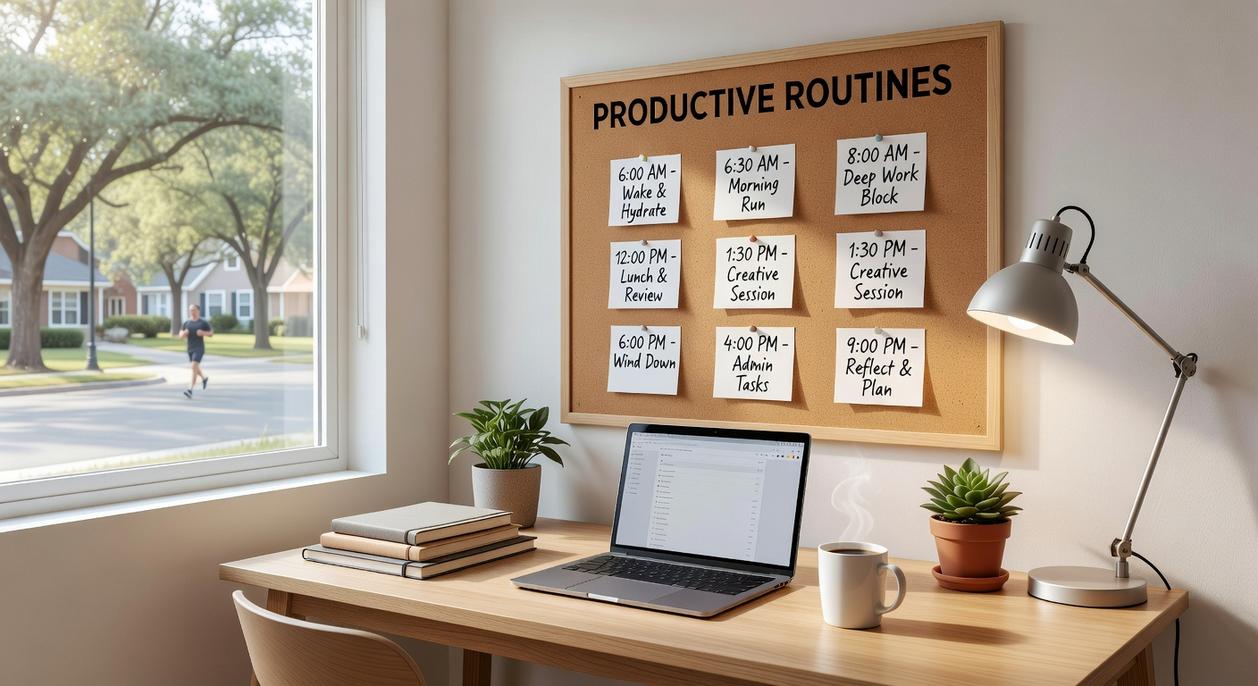
Midday slumps aren’t a personal failure—they’re biological. Your brain runs on cycles of focus and fatigue called ultradian rhythms (90–120 minute energy waves). Instead of fighting them, work with them.
Habit 4: Master the “Productivity Pulse.”
Use the Pomodoro Technique: 25 minutes of focused work, followed by a mandatory 5-minute break. That break isn’t optional—it’s a cognitive reset that prevents mental residue (the lingering thoughts from your last task) from draining the next one. Set a timer. Protect the sprint. Honor the pause. Repeat four times, then take a longer break.
Habit 5: The “Digital Declutter.”
After lunch, schedule 10 minutes to close unused tabs, file stray downloads, and clear notifications. Open tabs act like visual to-do lists (and your brain keeps scanning them). Reducing this cognitive load—the total mental effort being used—frees up bandwidth for deep work. Think of it as clearing your desk before starting a new project (future you will be grateful).
Habit 6: Fuel Don’t Falter.
Choose protein-forward lunches: grilled chicken salad, Greek yogurt with nuts, hummus and veggies, or eggs with whole-grain toast. Avoid high-sugar snacks that spike glucose and crash energy (Harvard Health notes blood sugar swings affect focus). Pair protein with fiber for steady output.
Actionable Tip: Strategic Pause Menu
- Walk outside for five minutes
- Listen to one favorite song
- Stretch your shoulders and hips
- Do box breathing (4-4-4-4)
Stack these daily productivity habits with your morning routine ideas to start your day with focus for sustained clarity.
The Evening Wind-Down: Setting Up Tomorrow’s Success Tonight
A productive day actually starts the night before. That’s where a simple wind-down routine makes all the difference.
Habit 7: The “Shutdown Complete” Ritual
First, review what you accomplished. Check off finished tasks and note any loose ends. Then, list the top 1–3 priorities for tomorrow. Finally—and this matters—say out loud, “shutdown complete.”
This phrase acts as a cognitive cue, meaning a mental signal that tells your brain a specific activity is finished. Research on implementation intentions shows that clear stopping points reduce mental fatigue and rumination (Baumeister & Tierney, 2011). In other words, you’re giving your brain permission to clock out (no overtime pay required).
Habit 8: The “Brain Dump”
Next, grab a notebook and spend five minutes writing down every open loop—tasks, worries, random ideas. Don’t organize; just unload. Psychologists call these unfinished tasks “Zeigarnik effects,” which linger in your mind until captured (Baumeister & Masicampo, 2011).
For example, if you keep thinking, “Email Sarah,” write it down. Once it’s on paper, your brain can relax. This small step supports better sleep and stronger daily productivity habits.
Habit 9: Prep Your Environment
Finally, reduce morning friction. Lay out clothes. Pack your bag. Clear your desk. Friction simply means tiny obstacles that drain energy. Remove them now, and tomorrow feels easier.
Actionable Tip: Shutdown Checklist
- Review completed tasks
- List tomorrow’s top 3
- Say “shutdown complete”
- Do a 5-minute brain dump
- Prep clothes and workspace
Do this nightly, and tomorrow starts on offense, not defense.
Your Daily Productivity System Starts Now
If your workday feels reactive and chaotic, I’ve been there. I used to blame overflowing inboxes and surprise meetings. The real problem? I had no system. I’d start fast, fade by noon, and scramble at night (not exactly a winning formula). That cycle felt inevitable—but it wasn’t.
The breakthrough came with a simple structure: Ignition, Momentum, Wind-Down. Ignition sets one clear priority before distractions hit. Momentum protects focused work blocks. Wind-Down reviews wins and resets tomorrow. This works because predictable structure conserves willpower—research shows routines reduce decision fatigue (Baumeister et al., 1998)—and builds positive feedback loops.
I once chased every shiny hack, thinking one tool would fix everything. It didn’t. Consistency beats novelty. Lasting results come from repeatable daily productivity habits, not magic apps.
So here’s your move: choose one habit for each phase and practice them for seven days. Start simple—plan one task, protect one hour, review one win. What could shift in a week?
Make Your Home Work Smarter, Not Harder
You came here looking for practical ways to simplify your space, streamline your routines, and make everyday living feel less overwhelming. Now you have actionable strategies you can start using immediately — from smarter organization to daily productivity habits that keep your home and schedule running smoothly.
The truth is, cluttered spaces and scattered routines drain your energy faster than you realize. When your home isn’t working for you, every task feels heavier. But with the right systems in place, small changes create big results.
Start by choosing one area to improve today. Apply one system. Test one routine. Build momentum from there.
If you’re ready to finally stop feeling behind in your own home, it’s time to take action. Explore more proven home solutions, smart living hacks, and step-by-step guides designed to save you time and reduce stress. Thousands rely on these practical strategies to transform their spaces — and you can too.
Don’t let disorganization keep stealing your time. Dive into the next guide now and start creating a home that supports your life instead of slowing it down.
 Founder & CEO
Thalira Norvessa is the kind of writer who genuinely cannot publish something without checking it twice. Maybe three times. They came to daily digest through years of hands-on work rather than theory, which means the things they writes about — Daily Digest, Wuta DIY Renovation Techniques, Lifestyle Organization Strategies, among other areas — are things they has actually tested, questioned, and revised opinions on more than once.
That shows in the work. Thalira's pieces tend to go a level deeper than most. Not in a way that becomes unreadable, but in a way that makes you realize you'd been missing something important. They has a habit of finding the detail that everybody else glosses over and making it the center of the story — which sounds simple, but takes a rare combination of curiosity and patience to pull off consistently. The writing never feels rushed. It feels like someone who sat with the subject long enough to actually understand it.
Outside of specific topics, what Thalira cares about most is whether the reader walks away with something useful. Not impressed. Not entertained. Useful. That's a harder bar to clear than it sounds, and they clears it more often than not — which is why readers tend to remember Thalira's articles long after they've forgotten the headline.
Founder & CEO
Thalira Norvessa is the kind of writer who genuinely cannot publish something without checking it twice. Maybe three times. They came to daily digest through years of hands-on work rather than theory, which means the things they writes about — Daily Digest, Wuta DIY Renovation Techniques, Lifestyle Organization Strategies, among other areas — are things they has actually tested, questioned, and revised opinions on more than once.
That shows in the work. Thalira's pieces tend to go a level deeper than most. Not in a way that becomes unreadable, but in a way that makes you realize you'd been missing something important. They has a habit of finding the detail that everybody else glosses over and making it the center of the story — which sounds simple, but takes a rare combination of curiosity and patience to pull off consistently. The writing never feels rushed. It feels like someone who sat with the subject long enough to actually understand it.
Outside of specific topics, what Thalira cares about most is whether the reader walks away with something useful. Not impressed. Not entertained. Useful. That's a harder bar to clear than it sounds, and they clears it more often than not — which is why readers tend to remember Thalira's articles long after they've forgotten the headline.