If you’ve ever wasted time searching for an important document, you already know the frustration of disorganization at home. From bills and warranties to medical records and school papers, paperwork piles up quickly—and without a clear system, it becomes overwhelming. That’s where a home filing system can completely change the way you manage your space and your peace of mind.
This article is designed to help you create a practical, easy-to-maintain filing setup that fits your lifestyle. Whether you live in a small apartment or a busy household, you’ll learn simple strategies to sort, store, and access documents efficiently—without overcomplicating the process.
We’ve researched proven organization methods, practical storage solutions, and real-world home management strategies to ensure the guidance here is both realistic and effective. By the end, you’ll have a clear plan to reduce clutter, protect important information, and build a system you can actually stick with long term.
From Paper Piles to Peace of Mind: A System That Works
If you’ve ever torn apart a drawer hunting for a birth certificate, you’re not alone. Nearly 55% of Americans say clutter is a major source of stress at home (UCLA Center on Everyday Lives of Families). Meanwhile, misplaced documents cost hours each year.
So, what’s the fix? First, gather every loose paper in one spot. Next, sort into four categories: keep, shred, act, archive. Then, label clearly and build a simple home filing system that mirrors real life—taxes, medical, home, warranties.
Most importantly, schedule a 10-minute weekly reset. Over time, this small habit prevents chaos from creeping back in again.
The Foundation: Gather, Sort, and Purge
Before you can build an organized system, you need a clean starting line. Think of this as pressing reset.
-
Step 1 – The Great Roundup
First, gather every single piece of paper from every corner of your home. Desks, drawers, kitchen counters, mail piles, random boxes—nothing gets a pass. Bring it all into one central location. A vs. B: scattered stacks across five rooms vs. one giant (slightly intimidating) mountain in front of you. The mountain wins. Why? Because you can finally see what you’re dealing with. -
Step 2 – The Three-Pile Method
Now divide everything into three clear categories:
- Shred Pile: Sensitive documents you no longer need—expired credit card offers, paid utility bills, ATM receipts. Keeping them risks identity theft (FTC recommends shredding documents with personal data).
- Scan Pile: Items worth keeping digitally but not physically—minor receipts, project notes, kids’ artwork. Paper clutter vs. searchable files? Digital usually wins.
- Keep Pile: Essential originals—birth certificates, legal paperwork, warranties. These form the backbone of your home filing system.
Some argue you should scan everything and ditch paper entirely. In theory, yes. In reality? Certain originals still matter. Even in our cloud-loving world (sorry, Marie Kondo), paper isn’t completely obsolete.
Creating Your Categories: A Blueprint for Your Files
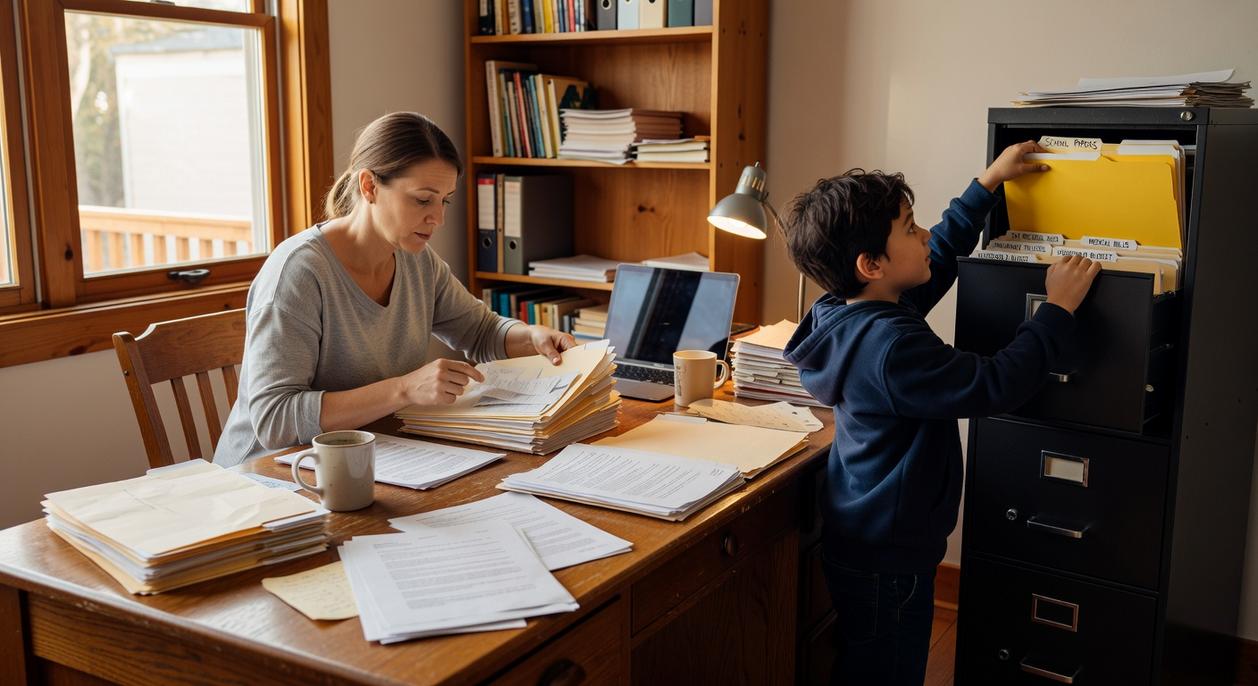
The core of any good system is logical categorization. In fact, organizing information into clear groups improves retrieval speed and reduces stress, according to research from Princeton University on physical clutter and cognitive overload (Princeton Neuroscience Institute, 2011). In other words, when your papers have a “home,” your brain relaxes a little.
So, how do you build categories that actually work in real life—not just on Pinterest? Start with these five:
-
Vital Records (For the Fireproof Safe)
These are irreplaceable documents. Think birth and death certificates, marriage licenses, passports, Social Security cards, property deeds, car titles, wills, and power of attorney documents. The FBI reports that identity theft affected over 1 million Americans in recent years (FTC, 2023), which makes secure storage non-negotiable. A fireproof, waterproof safe isn’t overkill—it’s smart. -
Financial & Tax
This covers tax returns (generally keep for seven years per IRS guidance), loan documents, investment statements, year-end credit card summaries, and bank statements. Although some argue that digital copies make paper unnecessary, the IRS still recommends retaining accessible records in case of audit. -
Household & Property
Mortgage documents or lease agreements, home repair receipts, appliance manuals, warranties, and property tax bills live here. Notably, warranty claims are far smoother when documentation is handy (and not buried in a junk drawer). -
Medical & Insurance
Store insurance policies, medical records, vaccination histories, and major medical bills together. Medical billing errors occur in up to 80% of bills reviewed by patient advocates (Medical Billing Advocates of America), so keeping records organized can literally save money. -
Personal & Employment
Employment contracts, resumes, performance reviews, and academic transcripts belong here. These documents often resurface during job changes (which, statistically, happen every 4.1 years on average per BLS data).
Altogether, this structure forms the backbone of your home filing system. If you’re tackling paperwork as part of a larger reset, start with decluttering your home room by room a practical action plan and build from there. Pro tip: label boldly and consistently—future you will be grateful.
Choosing Your Tools: Physical vs. Digital Systems
With your papers sorted, it’s time to build your storage system. The most effective setups aren’t either/or—they’re layered. A hybrid model protects what matters while keeping daily life friction-free (because no one wants to dig through a drawer during tax season).
The Physical System: For What Cannot Fail
Physical copies are best for vital records and documents that may be required in original form.
- Filing Cabinet or File Box: Use hanging folders with clearly labeled tabs. Create a main category like “Auto” with sub-folders for “Title,” “Insurance,” and “Repairs.” This structure reduces visual clutter and speeds retrieval.
- Binders: Ideal for living documents. A “Home Manual” binder can house appliance warranties, paint colors, and contractor contacts. A dedicated medical binder per family member keeps histories accessible during appointments.
Pro tip: Store your most critical originals in a small fireproof, waterproof safe inside your home filing system for added protection.
The Digital System: For Access and Efficiency
Digitizing reduces paper bulk and creates searchable backups.
- Scanning: Use smartphone apps like Adobe Scan or Microsoft Lens to capture clean PDFs in seconds.
- Cloud Storage: Mirror your physical categories in Google Drive, Dropbox, or OneDrive. Follow a consistent naming format like “2023TaxReturnFederal.pdf” for easy sorting.
Security Is Paramount
Enable strong passwords and two-factor authentication on all cloud accounts. According to the Cybersecurity & Infrastructure Security Agency (CISA), multi-factor authentication significantly reduces unauthorized access risk.
Some argue fully digital is simpler. But outages, hacks, and human error happen. Others insist paper-only feels safer. Yet paper burns, floods, and gets misplaced. The hybrid model quietly solves both problems—resilience without redundancy overload.
Staying Organized: The 5-Minute Weekly Habit
An organizational system is useless if it isn’t maintained (we’ve all watched neat piles slowly morph into chaos). The solution isn’t a weekend overhaul—it’s consistency.
Create a “To-File” Inbox. Designate one tray or basket where every new paper lands immediately. Researchers at Princeton University found clutter competes for your attention, reducing focus and increasing stress. One single entry point limits that visual noise.
Schedule a Weekly Sort. Set aside 5–10 minutes each week—Sunday evening works well. According to productivity studies from the American Psychological Association, short, scheduled maintenance habits are more sustainable than large, infrequent cleanups.
Act Immediately. During your sort, touch each paper once: shred junk, pay and file bills, scan receipts, and move documents into your home filing system. Handling items immediately follows the “touch-it-once” principle used in lean workflow management.
This tiny routine prevents backlog, saves time long term, and keeps paper chaos from staging a comeback.
Bring Order Back to Your Space for Good
You came here looking for a simpler way to manage the paper clutter, digital chaos, and everyday disorganization that’s been draining your time and energy. Now you know exactly how to create a home filing system that keeps everything sorted, accessible, and stress-free.
The truth is, disorganization isn’t just messy — it costs you time, focus, and peace of mind. When important documents go missing or piles keep growing, frustration builds fast. A clear, practical system changes that. It gives you control, saves you hours, and makes daily life smoother.
Now it’s time to act.
Start by setting up your categories, gather your folders or digital tools, and commit to maintaining your home filing system weekly. If you want more smart, practical home solutions that actually work, explore our proven organization guides and step-by-step hacks trusted by thousands of readers who’ve transformed their spaces.
Stop letting clutter run your home. Put your system in place today and enjoy the clarity you’ve been missing.
 DIY & Smart Living Specialist
Alico Erbyons has opinions about smart living hacks. Informed ones, backed by real experience — but opinions nonetheless, and they doesn't try to disguise them as neutral observation. They thinks a lot of what gets written about Smart Living Hacks, Knowledge Corner, Lifestyle Organization Strategies is either too cautious to be useful or too confident to be credible, and they's work tends to sit deliberately in the space between those two failure modes.
Reading Alico's pieces, you get the sense of someone who has thought about this stuff seriously and arrived at actual conclusions — not just collected a range of perspectives and declined to pick one. That can be uncomfortable when they lands on something you disagree with. It's also why the writing is worth engaging with. Alico isn't interested in telling people what they want to hear. They is interested in telling them what they actually thinks, with enough reasoning behind it that you can push back if you want to. That kind of intellectual honesty is rarer than it should be.
What Alico is best at is the moment when a familiar topic reveals something unexpected — when the conventional wisdom turns out to be slightly off, or when a small shift in framing changes everything. They finds those moments consistently, which is why they's work tends to generate real discussion rather than just passive agreement.
DIY & Smart Living Specialist
Alico Erbyons has opinions about smart living hacks. Informed ones, backed by real experience — but opinions nonetheless, and they doesn't try to disguise them as neutral observation. They thinks a lot of what gets written about Smart Living Hacks, Knowledge Corner, Lifestyle Organization Strategies is either too cautious to be useful or too confident to be credible, and they's work tends to sit deliberately in the space between those two failure modes.
Reading Alico's pieces, you get the sense of someone who has thought about this stuff seriously and arrived at actual conclusions — not just collected a range of perspectives and declined to pick one. That can be uncomfortable when they lands on something you disagree with. It's also why the writing is worth engaging with. Alico isn't interested in telling people what they want to hear. They is interested in telling them what they actually thinks, with enough reasoning behind it that you can push back if you want to. That kind of intellectual honesty is rarer than it should be.
What Alico is best at is the moment when a familiar topic reveals something unexpected — when the conventional wisdom turns out to be slightly off, or when a small shift in framing changes everything. They finds those moments consistently, which is why they's work tends to generate real discussion rather than just passive agreement.